

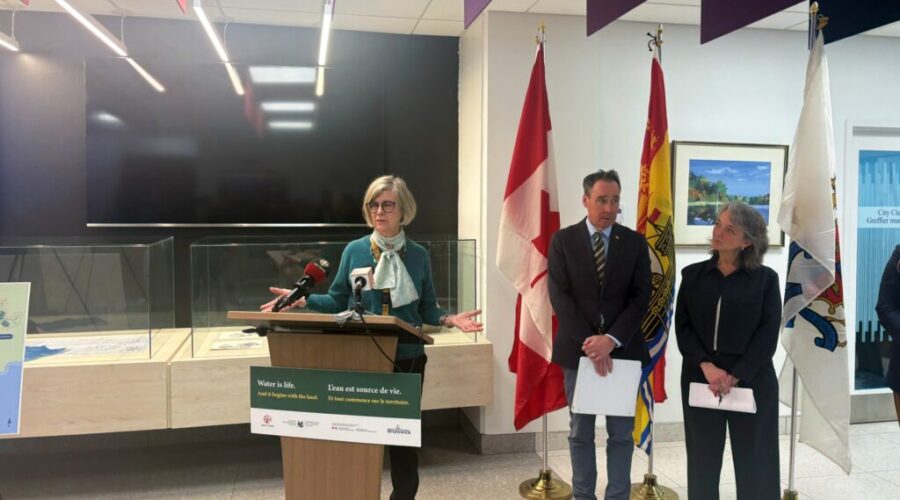
The City of Saint John is protecting its drinking water through a new conservation project.
Through a partnership between the city, the Nature Conservancy of Canada, and the federal and provincial governments, more than 4,800 hectares of Saint John-owned land within the Loch Lomond and Spruce Lake watersheds have received special conservation status.
The city announced the project at a news conference this afternoon.
Mayor Donna Reardon said mature, intact forest, lake shorelines and rich wetlands in the area are now recognized as Other Effective Area-Based Conservation Measures, or OECMs.
OECMs are geographically defined areas — not formally protected as parks — that are managed to achieve positive, long-term, local biodiversity conservation. They differ from protected areas because conservation is often a secondary, yet effective, outcome of their activities.
According to Reardon, the designation will allow the city to adopt stronger, long-term management practices and update several policies to better protect these lands for decades to come.
“Protecting our drinking water is one of the most important responsibilities we have as a city,” she said. “By securing these watershed lands for the long term, we are strengthening the health and resilience of our community.”
Reardon added that by better protecting the healthy forests and wetlands, the project will safeguard water quality and quantity, reduce water treatment costs through natural filtration, support overall ecosystem health and lower public health risks.
The areas will also contribute to the province’s target of conserving 15 per cent of land by 2027, and to Canada’s commitment and global efforts to conserve 30 per cent of lands and waters, said Julie Dabrusin, Federal Minister of Environment, Climate Change and Nature.
“Today’s announcement is a great example of the leadership municipalities like Saint John are showing when it comes to conservation,” Dabrusin said.
She said the achievement is the result of two years of collaboration that also received support from Environment and Climate Change Canada, through the Natural Heritage Conservation Program, as well as private donors.
With this new designation, the city will continue to manage the lands, balancing the ecological and social needs of the community.
The city will also work closely with the Atlantic Action Coastal Program to monitor water quality in its watersheds.