


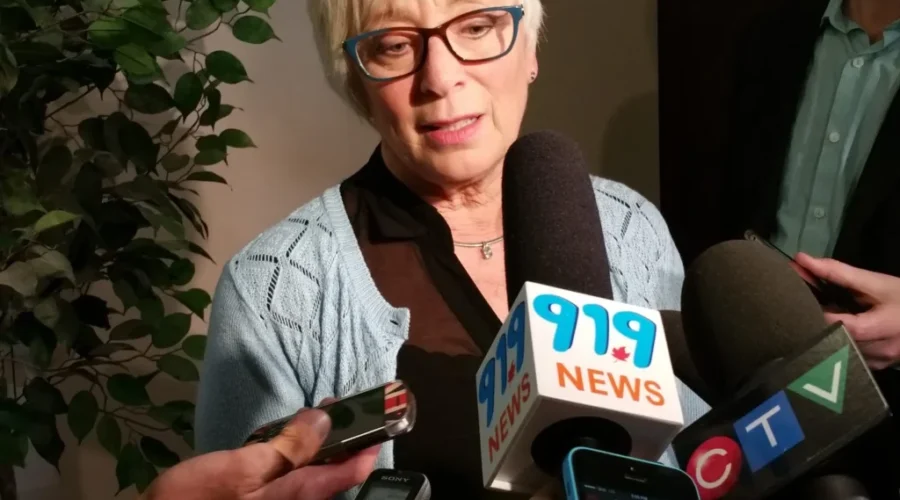
Despite the downgrading of New Brunswick’s debt from stable to negative by the credit rating agency Dominion Bond Rating Service, the provincial Finance Minister isn’t making changes.
Cathy Rogers says they are sticking with their latest plan to return to fiscal balance by 2021-2022, but they are treating this downgrade as warning.
“It is exactly why we are investing where we are, we’re investing strategically, and while we know economic growth has slowed, we are still on the growth incline as opposed to decline as in past years,” says Rogers.
Investments this government is making now will grow the economy in the short-term and avoid bigger problems down the road. Our plan is working as designed. We’ve cut the budget deficit in half while making record investments in Healthcare and Education.
— Cathy Rogers (@ROGERSatMoncton) February 27, 2018
Although a credit rating agency has recently changed its outlook, our actual credit rating remains unchanged at A (high). We are strategically managing our debt in order to continue to enact positive fiscal and economic policy.
— Cathy Rogers (@ROGERSatMoncton) February 27, 2018
NB last suffered an actual credit downgrade in 2012 under Blaine Higgs tenure as Finance Minister. Higgs’ deep budget cuts, routinely missed targets, and a floundering economy were blamed as reasons for the downgrade.
— Cathy Rogers (@ROGERSatMoncton) February 27, 2018
In response to the 2012 credit rating downgrade, Blaine Higgs called for deeper, faster cuts, even if it meant “rioting in the streets.” This government vehemently disagrees. Deep cuts to the programs New Brunswickers rely on is the last thing we need.
— Cathy Rogers (@ROGERSatMoncton) February 27, 2018
Today @BrianGallantNB has sent @ROGERSatMoncton out to tell lies about DBRS downgrade. Tomorrow at 3 pm he has to face Blaine Higgs at committee. Will Gallant perpetuate Roger’s lies or be forced to tell the truth? #nbpoli pic.twitter.com/WO2PKWLGuY
— NBOfficialOpposition (@NBOpposition) February 27, 2018
In 2015, Auditor General Kim MacPherson said despite an increase in revenue of $261 million, mainly through a HST hike from 13% to 15%, the province still ran a deficit because they increased spending by $362 million.
In 2017, if net debt was to be paid off by contributions from New Brunswickers, it would take $18,300 per person to pay it off, that’s compared to $9,483 per capita in 2008.