


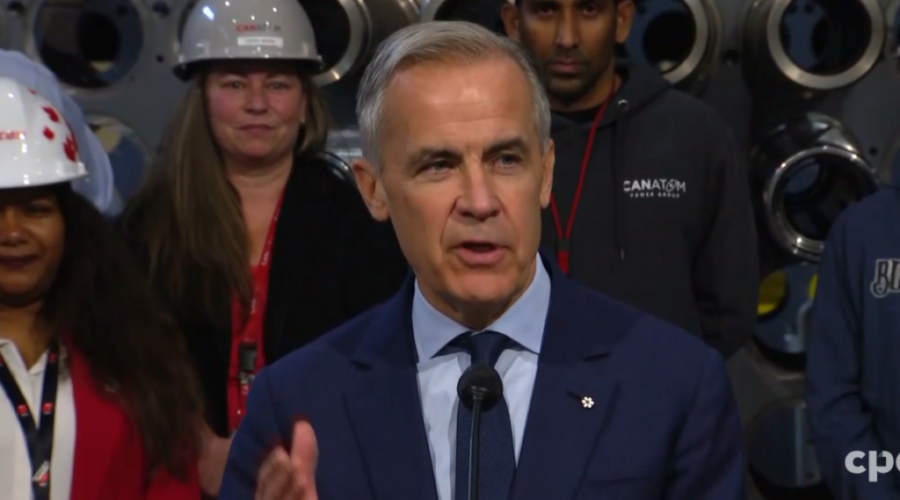
Prime Minister Mark Carney visited Martinrea, an auto parts manufacturing facility in Vaughan, Ontario, to announce the federal government’s new automotive strategy.
The strategy aims to drive down emissions by more than doubling the strictness of Canada’s vehicle greenhouse gas emissions standards for new vehicles.
By 2035, Carney is targeting 75 percent of new cars sold in Canada to be electric. By 2040, the hope is 90 percent.
“The more stringent emissions standards focus on results that matter to Canadians, while avoiding placing undue burdens on the Canadian auto industry,” said Carney.
The federal government will dedicate $3 billion from the strategic response fund and $100 million from the regional tariff response initiative to help businesses respond to trade disruptions, help pivot operations, retool plants to increase productivity, invest in advanced manufacturing, and expand into new markets.
The Canadian government will leverage these investments to maximize opportunities for Canadian suppliers, including steel and aluminum.
“In a strong domestic market – and we have a strong domestic market – we can buy what we build,” said Carney before announcing the launch of a new $2.3 billion program that incentivizes the purchase or lease of electric vehicles.
The program offers up to $5,000 for electric vehicles and up to $2,500 for plug-in hybrids.
The vehicles will have to be priced under $50,000 and be made by countries with which Canada has free trade agreements to qualify for the incentive. This does not include a country like China, which is under a recent agreement to import and sell vehicles in Canada.
Canadian-made vehicles will not be price-capped for incentive eligibility to further support Canadian automakers.
The federal government also wants to make EV charging easier and more convenient.
“We are developing a new national charging infrastructure through $1.5 billion of investment through the Canadian infrastructure bank. So, wherever you live in Canada, charging your vehicle should become as simple as filling your gas tank.”
Carney assures that Canada continues to favour a zero-tariff regime with the United States and autos. However, if the US insists on auto tariffs during the CUSMA review, Carney says the federal government will ensure that companies selling vehicles in Canada are strongly incentivized to produce in Canada.
“To support this objective, we will explore strengthening our automotive remissions framework through a tradeable credit system that would reward companies that produce and invest in Canada.”
“We have a strong view that the most effective, strongest, resilient, competitive, affordable auto sector in North America is one where vehicles and parts continue to move across our borders tariff-free. That view is shared by the Detroit automakers as well, and we’ll be working hard to accomplish that. If that is not the case, we’re putting in place a series of measures for production in Canada for Canadians for exports to the world,” Carney said.
Canada’s recent agreement with China will allow a limited number of Chinese EVs to enter the Canadian market, fewer than 50,000 a year in a market of 1.8 million cars. This agreement provides Canadians with more affordable, energy-efficient options, according to Carney.
“As we transform our auto sector into a global leader in electric vehicles, we’re working to protect workers and businesses today so they can bridge to the economy of tomorrow. We’re providing additional income support to workers and employers through a new work-sharing grant, giving them the flexibility that employers need to retain workers and prevent layoffs.”
Carney said this income support has helped prevent more than 3700 layoffs in the auto sector alone.
“We’re breaking down barriers and working together across government, industry and labour with a shared focus on delivery.”