


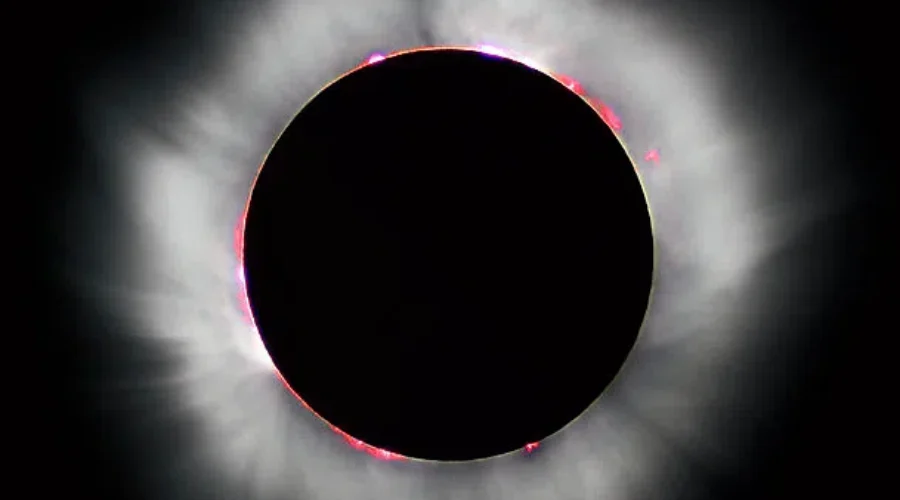
Today you can see an infrequent natural phenomenon when the moon passes between the Sun and Earth in a solar eclipse.
The Backyard Astronomer Gary Boyle says it’s been about a century since North America saw a total solar eclipse.
“The actual umbra, or the dark path where the Sun will be completely blocked out will be about 112 kilometres wide,” says Boyle. “It starts in Oregon at about 3,800 kilometres per hour, and ends up in South Carolina at about 2,400 kilometres per hour.”
Boyle warns everyone to never look at the Sun directly, adding even expensive sunglasses won’t protect your eyes.
He recommends creating a pinhole camera out of a shoebox instead.
“And you would put a piece of foil on one end of the box, put a little pinhole in it, and then it projects the image on the other side, so you’re not looking at the Sun you’re looking at a projection,” says Boyle.
He adds it is a really spectacular, and even angelic sight, and a once in a lifetime opportunity.
Meantime, there are a few of local organizations who will be offering the chance to view the solar eclipse as a group..
Spokesperson for the New Brunswick Branch of the Royal Astronomy Society of Canada Emma MacPhee says they will be meeting in the field beside the Riverview Kinsmen Centre, “The maximum coverage of the moon over the sun is going to be at around 3:48pm, and then it is going to exit on the other side by around 4:30 or so.”
She says you may notice a few unusual things going on around you, “It is going to get darker and the animals change their behaviour a bit.”
Astronomy Moncton will also be teaming up with Resurgo Place to offer a viewing party there as well. Activities get underway at 1 o’clock..There is also a viewing available at Universite de Moncton.
(Photo credit: Luc Viatour / https://lucnix.be/)