

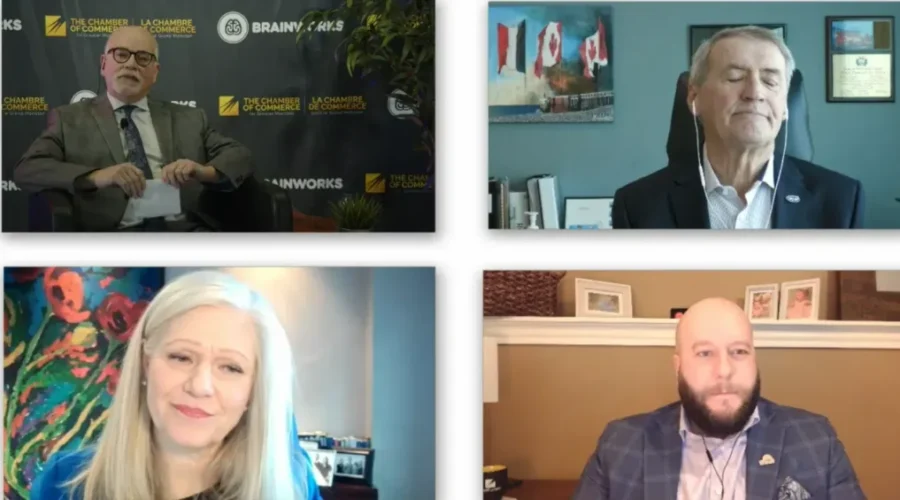
The mayors representing Moncton, Riverview and Dieppe had the opportunity to provide insight on issues in the community and subjects of topical interest on Thursday.
Presented by the Chamber of Commerce for Greater Moncton, the sixth annual State of the Tri-Communities, occurred virtually using pre-recorded interviews with each mayor, followed by a live question and answer period.
John Wishart, the CEO for the CCGM, hosted the event and asked the mayors a mix of predetermined and viewer-submitted questions.
Pandemic
The first question asked the mayor’s potential strategies that can be used to mitigate the impact the pandemic has on the business community, as well as promote physical activity and organized sports.
For Moncton Mayor Dawn Arnold, the intent is to continue supporting local businesses on the frontlines while also using their powers to voice concerns.
“We will continue to use our voice to push the province to support businesses in general and key sectors specifically. I think we all know that some industries have been more severely impacted like hospitality, tourism, arts, fitness, beauty. They’ve really suffered the most, so we need to support these sectors specifically so that they survive,” said Arnold, who added they will also find ways to be there for the businesses that cannot survive.
Arnold added from a recreational perspective, COVID has demonstrated the importance of public gathering space and touted the outdoor spaces available in Moncton, specifically referring to Centennial Park and the recently implemented Muskrat Trail.
Riverview Mayor Andrew LeBlanc echoed the importance of supporting business and noted they have had to pivot their communication methods to converse with local companies.
Changes have also been required to ensure they continue to offer residents the same events such as the Riverview Winter Carnival.
“Our parks and recreation department has done a great job pivoting and making sure there is a number of activities available so that regardless of where we are in the various phases of COVID-19, we’re still able to put on great events and provide excellent recreation opportunities for our residents,
The question prompted a quite different response from Dieppe Mayor Yvon Lapierre.
“We have to live with it but how we live with it and how we choose to act is an individual thing as we’ve noticed over the past few days what has taken place in some of our friendly cities. So, we changed things a little bit, try to accommodate where we can, but generally from our perspective, we have to follow the rules and that’s what we’ve been doing.”
Collaboration
A question on collaboration between the three communities asked for examples that have ensured the growth of the region.
LeBlanc, who is serving his first term as mayor after being elected last spring, expressed gratitude for being able to learn from his counterparts, over his first few months in the role.
“I think there’s a great foundation that already exists for how well the three municipalities work together.”
With plenty of experience in the role, Lapierre spoke highly of the collaboration between the communities and stated he hopes to see it continue in the future.
Lapierre noted the relationship between the tri-communities has not always been friendly, though in recent years it has improved.
“We share the good water coming in, and we share the water going back, so it’s a real full circle in that respect, “said Lapierre laughingly.
Highlighting significant examples of collaboration, Arnold called them “amalgamated” on the items that are most expensive such as policing, freshwater, wastewater, and transit.
“I would say communication is another fundamental one where our administrations work together. I think during the last two years it’s been really important that we have consistent messaging going out as a tri-community,” Arnold remarked.
Social issues
A question posed by a member of the business community asked for KPIs (Key Performance Indicator) or metrics on homelessness and crime, stating on many occasions they have had to escort homeless people off their property.
“Being homeless or unhoused is not a crime,” said Dawn Arnold, who noted the actions listed in the report on homelessness and downtown security can be used to track progress, and listed the ongoing initiatives directed at solving these issues
Among those in motion is the Rising Tide development, which has already opened over a dozen units.
“Housing is critical, if you do not have a place to live it is very difficult to get your life together,” Arnold said.
Despite the perception these issues are solely affecting the City of Moncton, LeBlanc acknowledged these issues are present in their community, though to a lesser extent.
In terms of solutions, he stressed the importance of collaboration between municipalities and local service providers.
“The challenge for us is really defining what role does our municipality play and how can we work together to develop a common strategy.”
“When we talk about homelessness, we also have to look at issues like mental health and addiction support and what are we doing to really address some of those things. I see the municipal role not necessarily as a service provider but a facilitator of bringing the key partners to the table.”
Lapierre reiterated they see the issues to a lesser degree, but they are involved with all of the efforts and initiatives.